|
Events
Happened Four Days of Unrest
“ I owe my crown and throne to God, my people, my army and your own
person.”
Shah’s words to Kremit Roosvelt
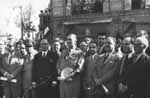
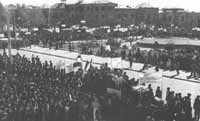
19 Auguest 1953 morning was a beginning to an end. Tehranians who had
three days of anxiety, demonstration and terror, observed this
artificial silence with wonder. Though strike was not declared, the
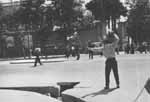
shops were half closed. The streets being swept of people added to
this anxiety. The voice of tumult and uproar could be heard from
Pahlavi cross-road and Sepah street. The optimism of people did not
last for long. The slogans of demonstrators were not what they
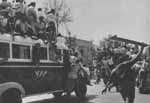
anticipated. The men mounted on the lorries had unfamiliar faces.
|
 |
 |
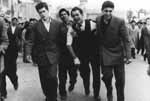
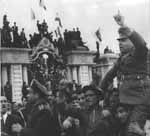
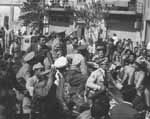
Some wore uniforms of uncommissioned
officers and those other resembled ruffians, blackmailers, and
hirelings. In their hands they held, Iranian national pictures of the
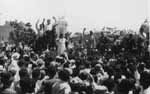
Shah and rods with which they threatened people, shouting: long live
the Shah, Down with Mossaddiq, Down with Tudehee. The people who were
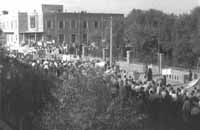
walking in Naderi street dispersedly watched them with wonder and
showed no reaction. At 10 o’clock in the morning the same program was
carried out in ToupKhaneh square. Shaban Jafari known as Shaban the
headless with his group of stabbers and ruffians, had turned this
place as his preserved area due to its being in the vicinity of his
ZourKhaneh. ( a place for traditional sports) In the west of the
square, one of this ruffians was turning a bloody Yazdi handkerchief
round his head and was threatening the opponents to murder. The
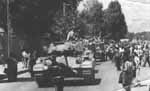
ruffians along with a large number of soldiers, non-commissioned
officers clothed in military or non-military uniforms started from
southern Tehran northwards and their destination were radio station
and the seat of prime minister in Kakh street. In the evening of the
same day all equipment of Dr. Mossaddeq’s house were put on sale in
Tehran streets.
|
 |
 |
Now we are faced with this question
that why within a few hours, the victorious man faced his failure.
While three days earlier, simultaneous with the Shah’s flight, all
people thought that Pahlavi dynasty had fallen and Mossaddeq has paved
the way for republic government. To find the answer we need go back to
some months earlier.
In 1952, the British lost their hope of overthrowing Mossaddeq cabinet
and establishing a new government not that much hostile to them. The
oil question became increasingly complicated. The situation reached to
a point that in late 1952 and early 1953 the British Intelligence and
security agents held a joint session with CIA authorities of middle
East and Africa in Washington. The purpose of this talks was the
overthrown of Mossaddeq government. This was the first time that, due
to their excessive weakness and loss of their interests in Iran, The
British satisfied themselves to have Americans as partner in enjoying
Iran.
|
 |
 |
In April 1953 United States gave her
consent to participate in these operations, and CIA allocated a budget
of one million dollars for this purpose. As it is said by one of the
coup planners just seventy and some thousand dollars were spent and
rest were given to the Shah.
The British ordered their members and agents to act under CIA. The
most active figures were Rashidian brothers (Seifol-lah, Qodrat-ol-lah
and Assad-ol-lah). In fact they were the main keys to British plans.
In second world war, Rashidian brothers cooperated with the British
against Germany and now they had held their organization. Further to
their wealth, they had influence in Majlis and Bazar; and they were
able to equip lay people who were influential in Iranian economy and
bring them to streets. The main prt of this joint operation, called
Ajax operation was to find a man to lead the coup forces and this was
Fazl-ol-lah Zahedi who was selected. His many acts has turned him to
one of main opponents of Mossaddeq.
|
 |
 |
In may 1953 the Americans consented
to Zahedi’s premiership. Simultaneous with this appointment, a
professional and veteran man was chosen for this operation in Tehran.
He was Kremit Roosvelt. He was a descendent of Theodore Roosvelt,
American president, and for many years, he was at the service of Near
East Department. In 1960, he left CIA and entered private enterprise.
Due to this cooperation he was esteemed by Iranian authorities
especially he had close relations with Ardeshir Zahedi.
Following the organization and planning the coup, they endeavored to
pave the way to operate the coup.
|
 |
 |
The economic situation of Iran, due
to oil embargo was in its most critical state. The salaries of
officials and labourers were delayed for some months. Inflation and
expensiveness of goods added to general poverty. The coup planners
understood the economic gravity and began a psychological warfare. The
press, the number of which amounted to more than 20 were in perfect
harmony with this plan. The main subjects of this psychological war
were:
1. Mossaddeq’s support of Tudeh Party and Soviet Union.
2. Mossaddeq’s being enemy to Islam because he cooperates with Tudeh
party and for the purpose of advancing their causes.
3. Mossaddeq’s conscious efforts to weaken army morale and their
competence to stablish order
4. Mossaddeq’s encouraging separatist tribes in order to provide the
Soviet domain over Northern provinces.
5. Mossaddeq’s corruption through his coming to power and his losing
all good aspects and acquiring all features of a despot.
|
 |
 |
In the anniversary of 21 July 1952
Tudeh party members held large meetings in Tehran and this worried
many religious and nationalist groups in Iran and unwantedly confirmed
CIA propogations of relations between Mossadeq and Tudeh Party.
Following the psychological war carried out with subtlety and its
influence among people, the operational stage of the plan began its
work and the Shah was informed of the Ajax operations. The mission was
undertaken by Shah’s twin sister, Ashraf Pahlavi. In an unexpected
journey in she entered Tehran and informed the Shah of the details of
the plan. She had mny important missions in her journey. First, she
convinced Shah of the joint and common goals of the British and USA,
and that he should set aside his fear of the “secret hands of the
British”. Secondly, she got official orders from Shah to appoint
Zahedi, as chief commander of army.

By 24 July all key foreign people
were present in Tehran including Roozvelt and Showartskopf, the former
being the main responsible of operations in Tehran and the latter
being the ex-chief of American military mission in Iranian Gendarmarie,
who now was Shah’s trustee. It is interesting to know that the son of
the very general in Kuweit-Iraqi war known as sand storm operations,
was the commander of allied forces. These two people with the help of
Ashraf pacified the coward Shah. In the meantime, Mossaddeq was mostly
worried about parliament. Some of the members opposed to him strongly
and the danger of interpellation threatened Mossaddeq. Meanwhile
Mossaddeq asked some of his supports to resign, and about 28 people
resigned in the parliament.
CIA operational staff in Tehran allured or threatened the members not
to resign. This resistance of members led Mossaddeq to make his
historical mistake and dissolve the parliament. According to the
constitutional law only Shah could decide on the dissolution of Majlis.
In 4 August a referendum was made and the majority consented to the
dissolution of Majlis. This provided an exceptional opportunity to
question Mossaddeq’s government. The newspapers added to their anti-Mossaddeq
propaganda plots. President Eisenhower in the very day of referendum
made a speech in the meeting of U.S. governors in Seatle and said
U.S.A will not let Iran go behind iron curtain. This was a secret
announce for the start of operations and an encouragement for the
Shah.
The plan was made ready for operation. In the evening of 11 August
Shah met General Zahedi and verbally appointed him prime minister and
flied to Ramsar with his wife, Sorayya Esfandiari. In the eve of 12
August colonel Ne’mat-ol-lah Nassiri, the commandant of Imperial guard
flied north and got Shah’s signature for appointing Zahedi and
removing Mossaddeq. In the north Shah was waiting for the success of
the coup.
In the meantime the psychological campaign against Mossaddeq reached
its climax. CIA agents mainly focused on frightening religious
leaders. Thus, on behalf of Tudeh party, they made strong
propagations, and published papers in which they threatened religious
leaders that if they opposed to Mossaddeq, they will be punished
terribly. In the name of Tudeh party, they made threatening calls to
some of them.
The operations began in the late 15 August, but due to lack of
coordination of Iranian agents and prolongation of executing orders
the coup was foiled. At eleven in the night some vans full of soldiers
arrested national leaders including Zirak Zadeh, HaqShenass and
Hossein Fatemi. Some pro-Mossaddeq officers were arrested. In the
morning of 16 August , colonel Nassiri accompanied with four vans of
soldiers and two jeep of steel-clads marched toward No. 109 in Kakh st.
that was Mossaddeq’s personal house, in order to submit his removal
order and the appointment of Zahedi, but Mossaddeq’s forces arrested
him.
Through the reaction of chief commander of Army, General Riyahi, the
coup was foiled. The news of abortive coup was published in the city
and the government issued a formal announcement. Anti-royalist
political groups demonstrated in the streets and the statues of Reza
Shah and his son were brought down. They changed the names of streets.
Zahedi and the coup agents took refugee in safe places and CIA agents
even spoke of their leaving Iran. These four days were the most uneasy
and disturbed days of the city. Strategic centers were under the eyes
of police, and armed forces and royal palaces wre closed.
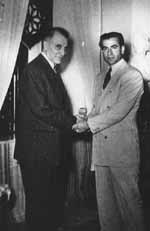
In the early hours of coup, the Shah with much fear left northern Iran
to Bagdad. When the news reached Tehran, the clashes between pro and
anti-Shah groups intensified and there was no hope of restoring
monarchy. During these four days, anti-Mossaddeq papers published
Shah’s orders to Zahedi. The demonstraters attacked to the bureaus of
newspapers and the capital had been turned to an embattled city.
Tehran was almost in the hands of anti-royalists groups. Many of
demonstrations were affiliated to Tudeh party and this fact created a
sort of fear among religious people. CIA operation staff was
desparetely planning for a new coup whthin the fes coming days
Rashidian brothers with their groups of ruffians attacked to the
political bureaus of many parties and robbed the shops of many people,
and this was considered a dangerous sign of the city’s falling into
the hands of communists. On the other hand, the coupist headquarters
contacted many military and police officers and distributed large
amounts of money among them. The happiness and festivity of triumph
and flight of Shah was to the extent that Mossaddeq’s Cabinet had been
lulled to sleep which ended in 19 August 1953 Coup.
|